Dignity For All
Beyond Rights & Equality
Lobbyists Advocate for Prostitution in Rhode Island and New Hampshire
Lobbyists Advocate for Prostitution in Rhode Island and New Hampshire
This op-ed was published at http://rinewstoday.net/home/news_description/125/Rhode-Island-Targeted-to-Decriminalize-Sex-Work
An admitted sex buyer has announced that he is heading-up a state-by-state lobbying campaign to decriminalize prostitution. His first targets are New Hampshire and Rhode Island.
Last year, a group called Decriminalize Sex Work contacted lobbying firms in New Hampshire looking for someone to advocate for bills to set up a study commission on the prostitution laws and decriminalize prostitution. Their ultimate goal is to legalize prostitution in private residences, hotel rooms, and licensed businesses everywhere in the United States.
According to the New Hampshire Secretary of State’s website, former Republican Senator Robert Clegg and Periklis Karoutas, both with the lobbying firm Legislative Solutions, work for Decriminalize Sex Work. So far, the lobbyists in New Hampshire have opposed a bill that will increase penalties against sex buyers who purchase underage victims: By all national and international standards, children cannot consent to commercial sex, and adults who pay for sex with children are serious criminals. So, why does a group that claims it is supporting legalizing consensual adult prostitution oppose penalties against predators who sexually abuse children?
In Rhode Island, Wally Gernt’s public relations firm, the Bradford Group, has been hired to lobby for bills supporting decriminalization of prostitution. In January and February of this year, the Bradford Group was paid $3000/month by Decriminalization of Sex Work (operating under the initials DSW in Rhode Island). On their monthly reports filed with the RI Department of State, lobbying for H5354, the bill to create a “study commission” on the prostitution laws is listed as their activity. The lobbyists include Chris Reilly with the Bradford Group and Melissa Broudo with an email address that connects her to the Sharmus Outlaw Advocacy and Rights (SOAR) Institute in New York. And starting in mid-March, Kaytlin Bailey from SOAR will start work earning $3000/month. She will be joined by Bella Robinson, from local COYOTE-RI, working pro-bono.
Decriminalize Sex Work says it is not a “wobbly startup organization.” Last month, in the Washington Examiner, its founder claimed to have raised $1 million so far. The group is headquartered in Austin, Texas, but chose New Hampshire and Rhode Island to start their campaign because they are small, liberal or libertarian states, where they think they might get easy victories, and start a national movement.
Decriminalize Sex Work has the perfect leader to advocate for the right of men to buy sex. A man who recently “came out” as a sex buyer. He seems to think it was a brave declaration of liberation. Although as an unmarried man, he admits it will be hard for many other men to “come out” as sex buyers because “usually their family or their girlfriend aren’t going to like to hear it.”
Bob Kampia is a former organizer for the legalization of marijuana, however, his behavior and attitude towards women have got him pushed out of that movement. Now, he has shifted his attention to decriminalizing prostitution.
There is a lot of talk about Kampia’s sexual harassment and office sexual misconduct in the Washington gossip columns. According to the Reliable Sourcein the Washington Post staff observed or endured his sexual “predatory behavior” numerous times. In 2010, he told a female employee that he wanted to give a woman who had gotten breast implants a “breast massage.”
One staff person said, “He was known as someone who made crude and inappropriate comments about and to women.” The final straw was when he had sex with a subordinate employee (Kampia admitted it was a repeat offense).
After being forced to resign and agreeing to get therapy for his attitudes toward women, he excused his behavior by saying, “I just think I’m hypersexualized”
It appears that Rob Kampia is a perfect kind of guy to advocate for the decriminalization of an industry that makes money from sexually exploiting women and girls. If anyone doubts what the decriminalization movement is about, look to one of its leaders.
Child-on-Child Sexual Abuse
This week, on March 20 & 21, at Catholic University in Washington, D.C., there is going to be a conference on child-on-child sexual abuse. “Out of the Shadows: Confronting the Rise of Child-on-Child Harmful Sexual Behavior.”
For more information. https://endsexualexploitation.org/cocsa/
If you can’t get to DC, there is going to be a live-stream of the conference. Free for government employees, students, or interns; $10 for the general public.
I know one of the promient topics of discussion will be children’s access to pornography and how that leads to acting out against other children, often family members.
Blueberry Cream Cheese Muffins

This morning I pondered on whether I should get to work writing or make muffins. Dan said, “Make muffins.” Here they are. Now, I’ll be ready for when my neighbor stops for coffee and a chat.
Strategies to Decriminalize Prostitution
Published at RINewsToday http://rinewstoday.net/home/news_description/119/Strategies-to-Decriminalize-Prostitution
Advocates of decriminalized prostitution are trying different strategies to legalize the sex industry.
So far, their approaches have failed—multiple times.
In California, in Berkeley in 2004 and in San Francisco in 2008, pro-prostitution advocates got their proposals for decriminalization of prostitution on the ballot, hoping that the general public would vote for decriminalization. They didn’t. The ballots lost in both cities.
Then in California, the pro-prostitution advocates sued District Attorneys and the Attorney General of California claiming that the prostitution laws violated their civil rights (Erotic Service Provider Legal Education and Research Project v. Gascon). They lost. They appealed the verdict to the United States District Court for the Northern District of California. They lost.
Now, they are trying to decriminalize prostitution state by state. They are looking for friendly legislators to introduce bills to decriminalize prostitution.
In New Hampshire–the “Live Free or Die” state—a legislator introduced a bill to decriminalize prostitution in 2016. It failed to get voted out of committee. The advocates then proposed a “study group” to review the prostitution laws. That attempt failed in 2017 and 2018.
Now, in Rhode Island, they have Representative Anastasia Williams introducing a bill to “study” the prostitution laws.
The New Hampshire and Rhode Island bills are similar. Both bills say the composition of the study groups will include representatives of known pro-prostitution advocacy groups. Their intent is obvious: Set up a process that will produce a report recommending the decriminalization of prostitution. Afterwards, they can wave their report around claiming that an official “commission” sanctioned by the legislature has recommended decriminalization of prostitution.
The pro-prostitution groups argue that the existing prostitution laws are unfair to women in prostitution and prevent poor women from earning a living.
Citizens should take a closer look at what decriminalization of prostitution means. Their claim to help women is just a front. They are really proposing to decriminalize the entire sex industry. Their proposed law changes will make it legal to buy sex, be a pimp, and run a brothel, a strip club with prostitution, a massage parlor—or any other type of commercial sex business.
Don’t let their supposed sympathy for the victims of the sex trade—the women (and sometimes men) in prostitution pull at your heart strings. Their real goal is to remove the restrictions to running brothels. This change will fill up the strip clubs (or gentlemen’s clubs as they are euphemistically known), which are known to be connected to organized crime associates, or the clubs will become targets for organized crime extortion rackets, as they have been in the past in Rhode Island. The Asian massage parlors will reopen, enriching Asian international organized crime groups that traffic women from Korea and China.
Rhode Island will become a sex tourist destination, attracting men who want to buy sex from all over New England—and beyond.
Poor, marginalized women, especially undocumented immigrants, will be recruited into prostitution. What an economic claim Rhode Island could make: “There’s always a job for women, here.” Jobs for pimps will be available to thugs. And women can proclaim that they support their boyfriends’ and husbands’ right to buy sex.
The pro-prostitution groups are increasingly well funded, so we’re going to have to put up with their agitation for some time to come. However, our response will always be: “No.”
Writing Machines of the Past

These portable manual typewriters were for sale on campus. They looked lonely. I wonder how many students—or reporters—may have used them in the past. I felt like I should take one home.
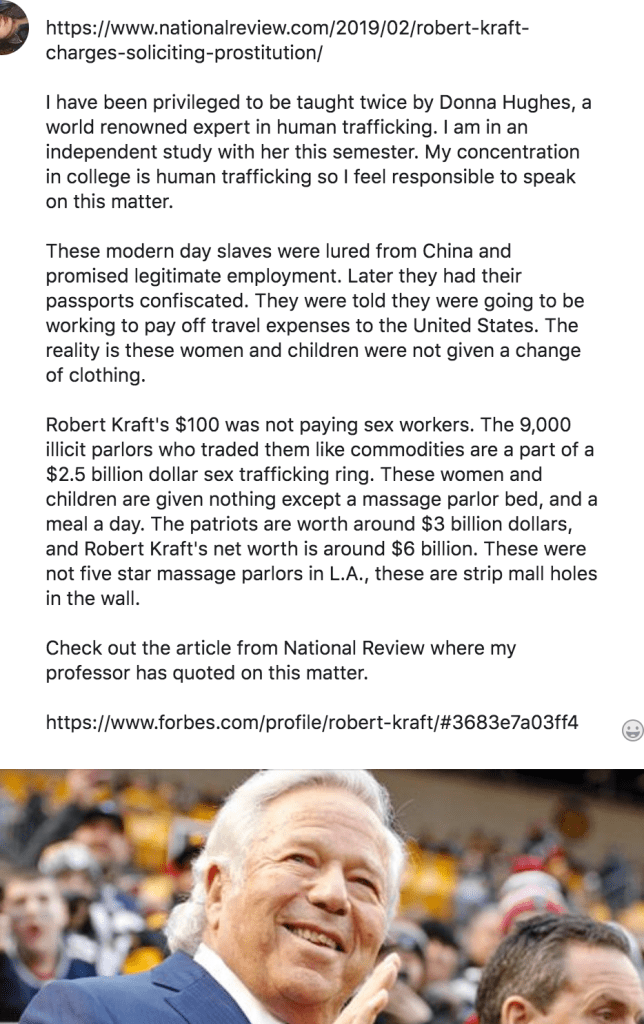
Student passionate about studying human trafficking
One of my independent study students for this semester–Sophia–mentioned me today on social media. I am pleased that so many of my students recognize the harm being done to women in the sex trade. They are passionate about wanting to fight this violation of human rights.
Sexual exploitation will be one of the themes I write about on this blog.
https://www.nationalreview.com/2019/02/robert-kraft-charges-soliciting-prostitution/
The Journey Begins
Thanks for joining me!
I’m getting things set up.

 Dignity For All